A Practical 36-Page Guide + 9 Working Tools

Earning Money From What You Already Know™

A practical guide to identifying, packaging and offering knowledge you already possess.

“I know things and have done things, but I do not know what any of it could become.”
See What the Guide Helps You Build ↓

The objective may be earning money. The guide does not promise that every skill can be monetized or that creating an offer will produce customers, sales, revenue or earnings.

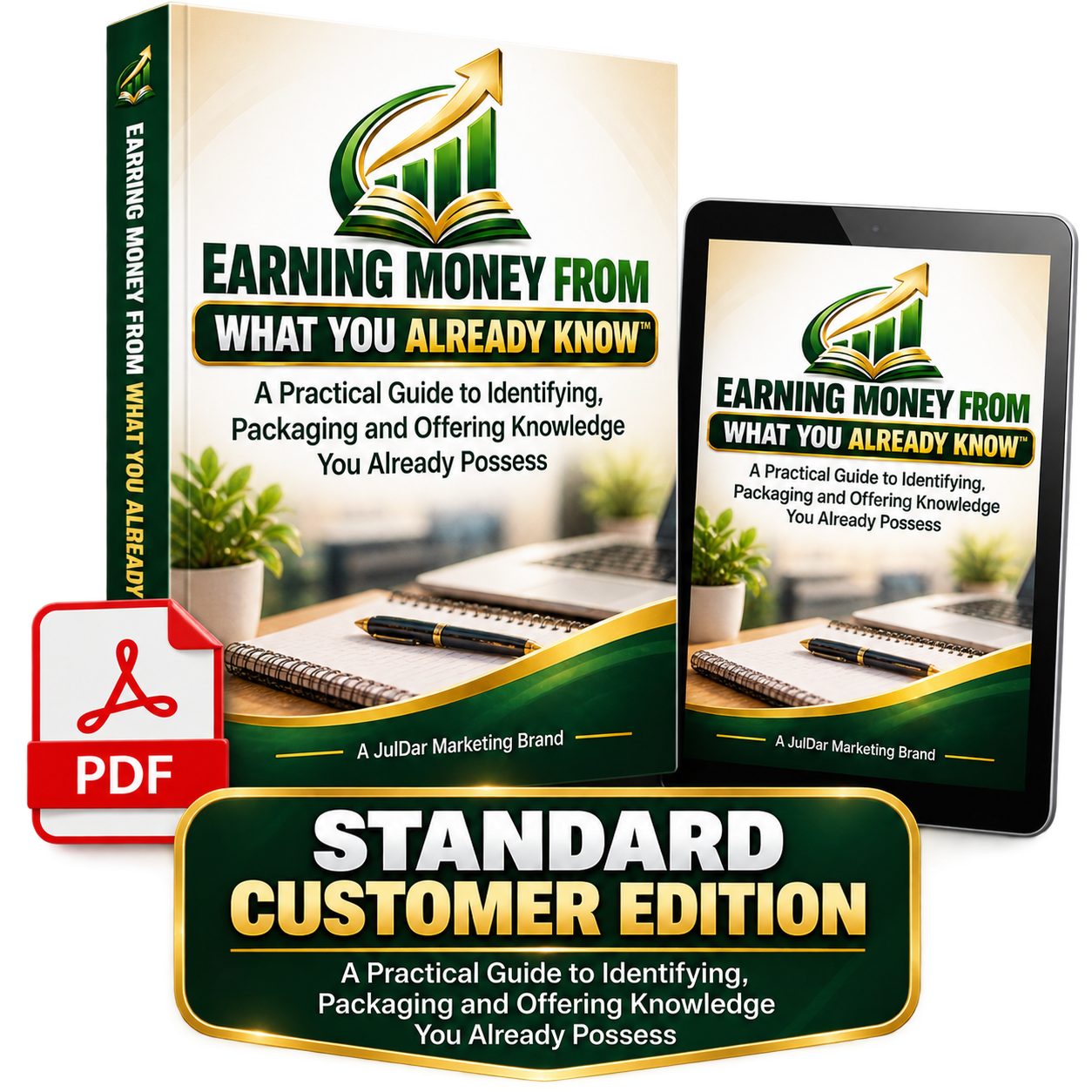
Standard Customer Edition and PLR Business Edition product bundles for Earning Money From What You Already Know
The Starting Problem

Useful experience can be hard to recognize when it feels ordinary to you.

People often assume that earning from what they know requires a groundbreaking idea, specialized credentials or an entirely new business concept.

Meanwhile, they may already know how to complete tasks, solve recurring problems, explain confusing processes, avoid mistakes or help another person get from one point to another.

  • What part of what I know is actually useful?
  • Who might need that knowledge?
  • What problem could it responsibly help address?
  • What should I turn it into?
  • How would I explain the offer clearly?
You may not need another completely new idea.

You may need a clearer way to examine the knowledge, experience and practical skills you already have.

Why We Miss What We Already Know

Familiar knowledge often does not feel valuable.

Something can feel simple to you precisely because you have already spent time learning, doing, correcting or repeating it.

1

It feels normal to you.

A process you have repeated for years may no longer feel difficult—even though someone encountering it for the first time may find it confusing.

2

You may focus on credentials instead of usefulness.

Formal qualifications matter in many fields, but not every useful piece of practical knowledge requires positioning yourself as a licensed professional or high-level expert.

3

You see experience, not a package.

Scattered lessons, skills and processes do not automatically look like a product. They need to be organized around a person, a problem and a useful form.

The Critical Distinction

Knowledge Is Not Yet an Offer.

Having experience is a starting point. Turning some of that experience into something another person can understand, evaluate and potentially buy requires additional decisions.

What You Know

Skills, experience, processes, lessons learned, repeated tasks, practical accomplishments and things you have learned to explain or do.

A Responsible Offer

A defined resource, service or learning experience for a particular person, addressing a recognizable problem, with clear boundaries around what you can responsibly provide.

The Five-Stage Method

IDENTIFY → MATCH → PACKAGE → POSITION → OFFER

The guide gives you a practical sequence for moving from “I know some things” toward one clearer offer candidate.

Stage 1

IDENTIFY

Inventory useful knowledge, experience, skills, processes and lessons learned.

Stage 2

MATCH

Determine who may benefit and what recognizable problem the knowledge could help address.

Stage 3

PACKAGE

Turn scattered experience into a defined resource, service or learning experience.

Stage 4

POSITION

Explain what the offer is, who it is for, what it helps with and what it does not promise.

Stage 5

OFFER

Choose a practical starting format and create a simple path for someone to evaluate or purchase it.

What You Will Work Through

Move from scattered experience to a clearer first offer.

The goal is not to make everything you know into a product. It is to examine your experience, narrow it down and make one more responsible starting decision.

Recognize useful knowledge that may have become too familiar for you to notice.
Separate knowledge, experience, skill and process instead of treating them as the same thing.
Look for repeated questions and recurring problems that may reveal where your experience is useful.
Narrow a broad subject into one recognizable problem rather than trying to help everyone.
Decide what you can responsibly teach, demonstrate or help someone implement.
Choose one practical starting format instead of trying to build every possible product or service.
Build a minimum useful offer around one intended user and one meaningful problem.
Explain the offer without promising results you cannot guarantee.
Inside the 36-Page Guide

Eight Parts. One Practical Progression.

Each Part moves you toward a more specific decision about what you know, who it may help and what you could responsibly offer first.

Part 1

You May Know More Than You Think

Examine why useful knowledge can feel ordinary, distinguish knowledge from unsupported expertise claims, and pay attention to repeated questions and recurring problems.

Tool: What Do People Already Ask Me About?™
Part 2

Inventory What You Already Know

Review work experience, personal projects, practical accomplishments, repeated processes, mistakes, corrections and skills that may help someone complete a task or avoid confusion.

Tool: Existing Knowledge Inventory™
Part 3

Find the Useful Problem

Move beyond a broad topic by identifying who may need help, what specific problem may matter and whether your knowledge has practical usefulness for that situation.

Tool: Knowledge-to-Problem Match™
Part 4

Decide What You Can Responsibly Offer

Consider what you can teach, demonstrate or help someone implement—and recognize where qualifications, licensing, professional boundaries or unsupported claims matter.

Tool: Responsible Offer Boundary Check™
Part 5

Choose the Right Package

Compare practical starting formats such as a guide, workbook, checklist, template, workshop, short course, consulting, coaching or freelance service—and choose one starting format.

Tool: Offer-Format Decision Sheet™
Part 6

Build the Minimum Useful Offer

Define one intended user, one meaningful problem, one practical outcome and what the buyer actually receives while removing material that does not belong.

Tool: Minimum Useful Offer Builder™
Part 7

Explain the Offer Clearly

State what the offer is, who it is for, what problem it addresses, what is included, what someone can realistically expect and what the offer does not guarantee.

Tool: Clear Offer Statement Builder™
Part 8

Establish a Practical Starting Path

Complete a first version, review it for usefulness and accuracy, select a delivery method, present it, observe questions and improve from evidence rather than assumptions.

Tool: First Offer Action Plan™
Not Just Reading

Nine Working Tools Help You Make the Decisions.

The guide includes practical worksheets and decision tools so you can work through your own knowledge instead of only reading about the concept.

Tool 1

What Do People Already Ask Me About?™

Look for repeated questions that may reveal where others already see usefulness in your experience.

Tool 2

Existing Knowledge Inventory™

Organize work experience, projects, skills, processes, accomplishments and lessons learned.

Tool 3

Knowledge-to-Problem Match™

Connect selected knowledge to a specific person and a recognizable practical problem.

Tool 4

Responsible Offer Boundary Check™

Clarify what you can responsibly offer and where claims, qualifications or professional boundaries require caution.

Tool 5

Offer-Format Decision Sheet™

Compare possible formats and select one practical way to package the knowledge first.

Tool 6

Minimum Useful Offer Builder™

Define the intended user, problem, practical outcome, essential steps and actual deliverable.

Tool 7

Clear Offer Statement Builder™

Turn the idea into a clearer explanation of what it is, who it is for and what it helps address.

Tool 8

First Offer Action Plan™

Establish the practical steps for completing, reviewing, presenting and learning from the first version.

Final Tool 9

WHAT I KNOW → WHO IT HELPS → WHAT I CAN OFFER PLAN™

Bring the major decisions together into one final implementation plan.

Final Implementation System

WHAT I KNOW → WHO IT HELPS → WHAT I CAN OFFER PLAN™

At the end of the guide, bring the major decisions into one practical plan so you can see the complete offer candidate in one place.

1.What I know
2.How I learned it
3.What problem it may help address
4.Who may need that help
5.What I can responsibly claim
6.What format fits the knowledge
7.What the customer will receive
8.How I will describe the offer
9.What I will create first
10.What evidence I will use to improve it
Is This the Right Starting Point?

This guide is built for a particular kind of starting problem.

This may be for you if…

  • You have work, life, project or practical experience but do not know what part of it could become an offer.
  • People sometimes ask you how you do something or how you solved a particular problem.
  • You have several possible ideas and need help narrowing them down.
  • You want to start with one practical resource or service rather than build an entire business system at once.
  • You want to describe what you can offer without making promises you cannot support.

This is not for you if…

  • You are looking for guaranteed income, customers or sales.
  • You expect every hobby or interest to automatically have profitable market demand.
  • You want a shortcut for claiming credentials or expertise you do not possess.
  • You want to ignore licensing, legal or professional boundaries that apply to a subject.
  • You expect creating a product to prove that people will buy it.
Realistic Expectations

Pursuing earnings is not the same as promising earnings.

This product is about developing a clearer offer candidate from knowledge you already possess. What happens after that depends on factors the guide cannot guarantee.

Creating an offer ≠ proving demand.

Organizing useful knowledge into a product or service can give you something concrete to present. It does not establish that a market exists, that buyers will choose it or that the offer will be profitable.

Earning money is the objective—not the guarantee.

The guide can help you make clearer decisions about what you might offer. It cannot guarantee customers, sales, revenue, profitability or any particular level of earnings.

What You Receive

One focused guide. One practical process.

No membership, product catalog or complicated training portal is required to work through the system.

Personal Customer Use Earning Money From What You Already Know Standard Customer Edition guide and digital PDF bundle

Standard Customer Edition

$27

For the customer who wants to work through the complete method and all nine implementation tools for personal or internal use.

  • Certified 36-page customer-facing PDF
  • Five-stage IDENTIFY → MATCH → PACKAGE → POSITION → OFFER method
  • Eight instructional Parts
  • Nine implementation and decision tools
  • No editing, redistribution, resale, PLR or MRR rights
Primary Business Package Earning Money From What You Already Know PLR Business Edition product bundle with editable and licensed business materials

PLR Business Edition

$97

For a business owner who wants the completed customer product plus the licensed materials needed to edit, rebrand and sell a finished version under the included PLR Business License.
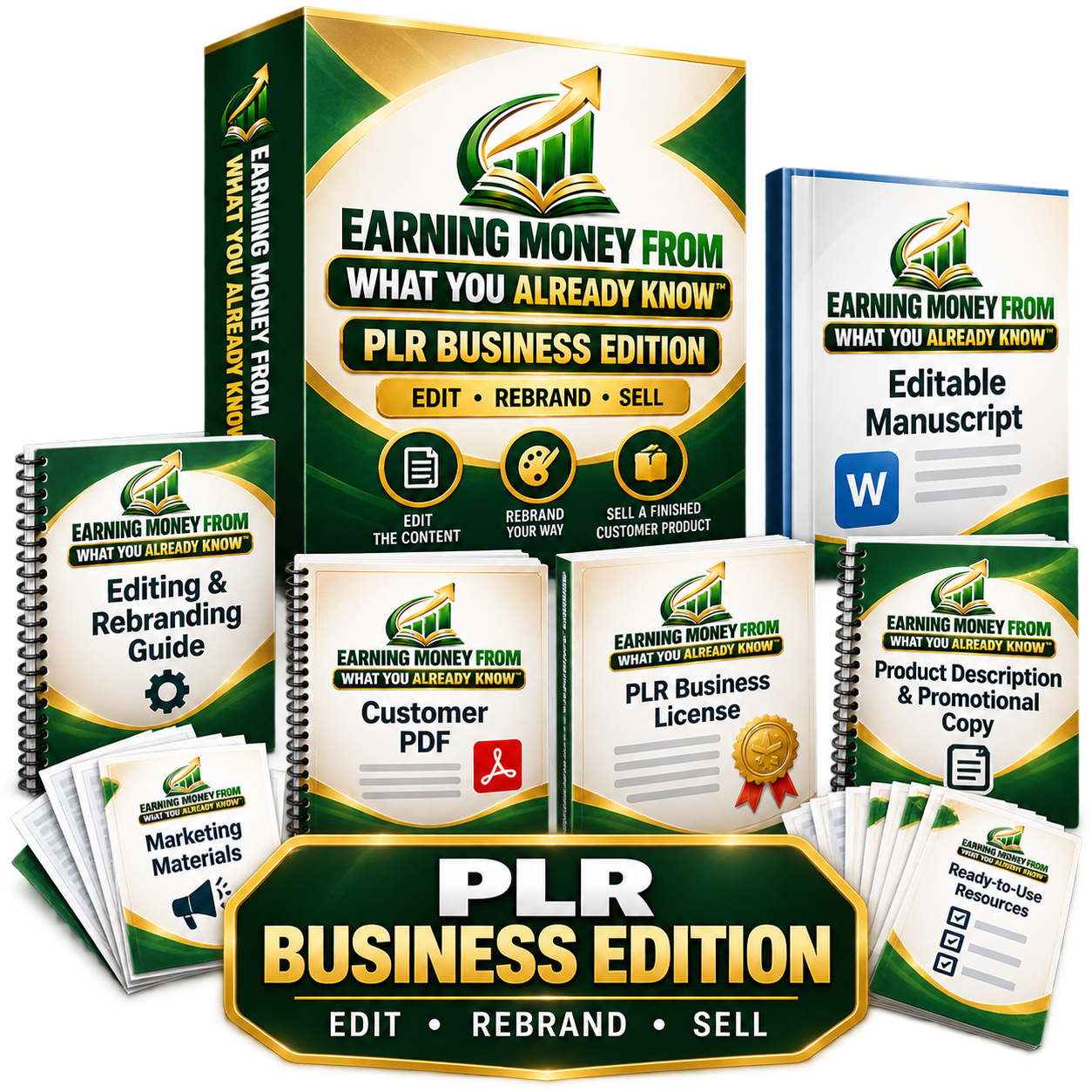
  • Editable DOCX manuscript
  • Certified 36-page customer PDF
  • PLR Business License and plain-language rights summary
  • Editing and rebranding guide
  • Promotional copy and approved visual assets
  • Package inventory and delivery guidance
Frequently Asked Questions

Before You Decide

Do I need to already have a business idea?

No. The starting point is the knowledge, experience, skills, processes and lessons you already possess. The guide helps you examine those inputs and narrow them toward a possible problem and offer candidate.

Does the guide tell me that anything I know can make money?

No. Not every interest, skill or piece of knowledge has practical market value, and creating an offer does not prove demand. The process is designed to help you examine usefulness more carefully rather than assume profitability.

What kinds of offers can I consider?

Starting formats covered by the guide include a guide, workbook, checklist, template, workshop, short course, consulting session, coaching session or freelance service. The goal is to choose one appropriate starting format—not build all of them simultaneously.

Do I need to call myself an expert?

No. The guide specifically addresses responsible offer boundaries and separating useful experience from unsupported expertise claims. You should only make claims that your actual experience and qualifications support.

What if my subject involves professional or licensed advice?

Relevant professional, legal, licensing and qualification requirements still matter. The guide does not authorize you to ignore those requirements or present yourself as qualified in areas where you are not.

Will completing the guide prove people want my offer?

No. Completing the process can help you create a clearer offer candidate. Market response must still be observed. Creating an offer and proving demand are two different things.

Does this guarantee I will earn money?

No. Earning money may be your objective, but the product does not guarantee customers, sales, revenue, profitability or earnings. Results depend on many factors outside the guide.

What should I have at the end?

The intended result is greater clarity about what you know, who it may help, what problem it may address, what you can responsibly claim, which starting format fits, what the customer would receive and what you should create first.

Your Next Step

Stop Looking Only for the Next New Idea.

Start by examining what you already know. Identify where it may be useful, connect it to a recognizable problem, choose one responsible format and turn the scattered experience into one clearer offer candidate.

Personal Customer Use Earning Money From What You Already Know Standard Customer Edition guide and digital PDF bundle

Standard Customer Edition

$27

Work through the complete guide and its nine practical tools to identify, package and describe one responsible offer candidate based on knowledge you already possess. Use the worksheets to examine what you know, connect that knowledge to a practical problem and establish a clearer starting path for creating your first offer.

  • Certified 36-page customer PDF
  • Complete five-stage method
  • All eight Parts and nine implementation tools
  • Customer-use rights only

Earning Money From What You Already Know™

The complete 36-page customer guide featuring the IDENTIFY → MATCH → PACKAGE → POSITION → OFFER method, eight instructional Parts and nine practical implementation tools. The complete 36-page customer guide featuring the IDENTIFY → MATCH → PACKAGE → POSITION → OFFER method, eight instructional Parts and nine practical implementation tools.

USD 27.00

No editing, redistribution, resale, PLR, MRR or resale-rights permissions are included with this edition.

Primary Business Package Earning Money From What You Already Know PLR Business Edition product bundle with editable and licensed business materials

PLR Business Edition

$97

Build from the completed product instead of starting with a blank page. Edit it, apply your own branding and sell your finished customer edition under the included license.

  • Editable manuscript and certified customer PDF
  • PLR Business License and rights summary
  • Editing and rebranding instructions
  • Promotional copy, visuals and package guidance

Earning Money From What You Already Know™ — PLR Business Edition

The complete licensed business package containing the editable manuscript, certified 36-page customer PDF, PLR Business License, rights summary, editing and rebranding guidance, promotional materials and package documentation. Use is governed exclusively by the included PLR Business License.

USD 97.00

You may edit, rebrand and sell a finished customer product as authorized by the included license. The underlying PLR rights may not be transferred or resold.

Earning Money From What You Already Know™ is an educational product designed to help customers identify, organize and responsibly package knowledge they already possess. It does not guarantee market demand, customers, sales, revenue, profitability or earnings.