Do You Want to Create a Business but Don’t Know What to Build It Around?
You do not need to pretend you already have a business idea. Start by looking at what you know, the problems it may help solve, and the people who may need that help.

The first decision is smaller than “What business should I start?”
First, find one piece of knowledge that may be useful to a particular person facing a particular problem. Then investigate whether there is a practical way to help.
How to identify knowledge you may be overlooking, connect it to a recognizable problem, describe a possible offer, and decide what to check before you build it.
You want a business. The blank page is the problem.
Someone else seems to know exactly what to sell. They have a topic, a name, maybe even a website. You sit down to come up with your own idea and get stuck at the first question: “What would my business even be about?”
It can feel as if a worthwhile idea must arrive all at once. You may dismiss things you have done for years because they feel ordinary to you. Or you may collect so many possible interests that none of them feels like a sensible place to begin.
Instead of asking yourself to invent a complete business today, ask what you already understand that another person may still be trying to figure out. That question gives you something concrete to examine. It does not require you to call yourself an expert or promise that someone will pay you.
Your knowledge is a starting point. It is not automatically a business.
Find the useful things you may have stopped noticing
What do people already come to you for?
You may be looking past a skill because it no longer feels difficult. The process you worked hard to learn five years ago may now take you ten minutes. Familiarity can make useful knowledge hard to recognize in yourself.
Think beyond formal credentials. Experience with organizing a process, explaining a confusing task, choosing tools, or helping someone avoid a mistake may be relevant. Credentials can matter in some fields, and you should respect the limits of what you are qualified to teach. But a certificate is not the only way to notice a problem you understand well.
Look at repeated questions
What do friends, coworkers, customers, or relatives ask you to explain more than once? Write the actual question, not a broad topic such as “technology” or “business.”
Look at a learned process
What can you now do that once took research, trial and error, or practice? Which steps are obvious to you but unclear to a beginner?
Make a short list of situations, not a list of grand business ideas. “I help people organize the documents they need before meeting a bookkeeper” is easier to examine than “I could do something with finance.”
What have you learned through experience? What problem have you learned to solve? What do people ask you to show them or explain?
“I know how to organize a simple client intake process.”
“New service providers lose track of inquiries and follow-up.”
“A solo provider handling their first steady flow of clients.”
Put a person and a problem next to what you know
Who might need help with this, and when?
A skill on its own is still broad. The clearer question is where it meets someone else’s difficulty. “I am good at spreadsheets” may mean very little to a stranger. “I can help a small service business organize inquiries in a simple tracker” begins to name a person, a situation, and a possible result.
Do not assume the first person you name is ready to buy. Talk with people in that situation. Listen for how they describe the problem, what they have already tried, and what kind of help they would actually use. A problem you can describe clearly may still be low priority for them, already well served, or outside what you can responsibly provide.
Who is struggling with a task you understand? What is confusing or time-consuming for them? How do you know this is their problem rather than your guess?
If you have several unrelated interests, use the person and problem as a filter. You do not need to force all your interests into one business. Choose one connection you can investigate first.
Shape one useful piece of help
What could someone actually receive from you?
People cannot use the sentence “I know a lot about this” by itself. They need to understand what you would help them do. A starting format might be a short guide, a checklist, a lesson, a template, or a service with a clear scope. The format should fit the problem, the person, and what you can reliably deliver.
For example, someone who has repeatedly helped neighbors prepare for a move might examine a move-planning checklist for first-time renters. The promise would need to stay within what the checklist can actually do. It cannot guarantee a stress-free move, and the person should not claim legal or financial expertise they do not have.
Now explain the idea in the reader’s language. “A checklist that helps first-time renters track moving tasks and documents” tells someone more than “my life-organization product.” You are positioning the help by the situation it addresses, not by a clever name.
Try this one-sentence working idea
“I know something about ___. It may help ___ with ___. I could responsibly provide ___ so they can ___.”
Leave it as a working idea. You have described a possibility to examine; you have not proved that people want to buy it.
Check the idea before you build around it
What would you need to learn next?
A useful description is progress. It is not a signal to spend weeks building a course, ordering inventory, or buying a collection of tools. First, find out whether the person you named recognizes the problem and whether your proposed help makes sense to them.
You might ask a few people in the situation how they currently handle it. You might show a brief outline of the proposed resource and ask what is missing or unclear. If you offer a service, define a small scope you can actually deliver and find out whether anyone wants that specific help. Listen to responses without treating compliments as purchases.
Describe one person, one problem, and one form of help.
Ask how the person handles the problem now and what matters most.
Refine, test on a small scale, or set the idea aside based on what you learn.
When you eventually present an offer, state what it includes, what it does not include, what it costs, and what someone can reasonably expect to receive. Keep your claims tied to what you can support.
Business possibility ≠ proven business demand. Knowledge may lead to an offer candidate. Customer interest, willingness to pay, delivery quality, costs, and results still have to be examined.
A one-page starting-point check
Use this before deciding that you have found your business. Write specific answers. “I do not know yet” is a useful answer because it tells you where to look next.
My working idea
- Knowledge: What do I know or know how to do? How did I learn it?
- Problem: Which specific task or difficulty could it help someone address?
- Person: Who faces that problem, and what evidence do I have that they recognize it?
- Scope: What could I responsibly help with? What would be outside my experience or qualifications?
- Format: Would a guide, template, lesson, service, or another format suit that problem?
- Description: Can I explain the help in one ordinary sentence?
- Next check: What conversation or small test would teach me whether this idea deserves more work?
If the answers are vague, narrow the problem or person. If no one recognizes the problem, revisit the match. If you cannot responsibly deliver the proposed help, change the scope. You are allowed to revise the idea before it becomes a product.
You do not need a perfect business idea to begin. Identify something you know, connect it to a real person’s problem, describe one responsible form of help, and check the idea before building around it.
Reflect
What do you understand today that once confused you? Who still faces that difficulty? What have they actually asked for help with?
Take one next step
Write your one-sentence working idea. Then speak with one person in the situation you named. Ask about their problem before presenting your solution.
A starting point is enough for the next decision
You may begin this exercise saying, “I don’t know what business to start.” A more useful place to end is: “I know something about this, it may help this person with this problem, and I can examine whether I could turn it into an offer.”
That statement does not guarantee customers or income. It gives you a direction to investigate without pretending the answer is already proven.
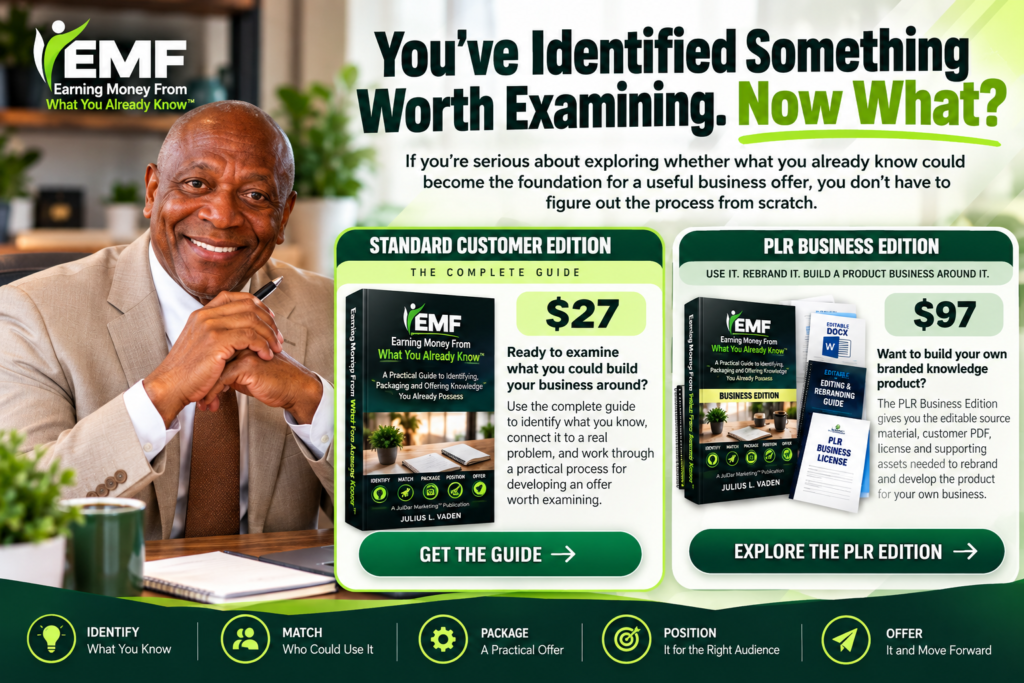
Want a structured way to work through your idea?
Earning Money From What You Already Know™ helps you examine your existing knowledge, consider who it may help, and shape a practical offer candidate. It is a guide to making clearer decisions, not a promise that an idea will produce sales or income.
Explore Earning Money From What You Already Know™ →